
Arthur “Mac” Millholland: Korean War Veteran and Stars and Stripes Correspondent
Arthur “Mac” Millholland’s Korean War story begins with a portable typewriter, an M-1 rifle, and a road somewhere near Taegu, South Korea, in 1951.
A veteran of the United States Army from Pleasant Prairie, Wisconsin, Millholland served with the 7th Infantry Division during the Korean War and became a correspondent for the Pacific Stars and Stripes. His work placed him close to the front lines, where he reported on soldiers, commanders, engineers, and the daily realities of war for readers in uniform.
Arthur “Mac” Millholland and the Legacy of Stars and Stripes
For Millholland, joining Stars and Stripes was more than a military assignment. It was a defining moment in his service and writing life.
“When I got there and saw the Stars and Stripes sign over the door, bells rang, whistles went off, and an almost physical flush of excitement came over me. I knew about the Stripes from my stint in Germany. We had been warned, however, that this was only going to be an interview. So the possibility of being a foot soldier in Korea still loomed.”
— Arthur “Mac” Millholland
Millholland had first encountered Stars and Stripes while serving in Germany after World War II. That early connection to military journalism would later shape his Korean War experience and lead him to one of the most important assignments of his Army service.
From Army Service in Germany to Korean War Correspondent
Before serving in Korea, Millholland enlisted in the Regular Army in September 1946. After basic training at Camp Lee, Virginia, he was sent to Cook and Bakers School before being reassigned to a very different role.
At just 19 years old, Millholland became the managing editor of a weekly newspaper for the 10th Constabulary Regiment in Böblingen, Germany. The assignment was challenging: the paper was printed in Stuttgart by a printer where no one spoke English, while Millholland knew very little German. Still, the paper was produced on time.
That early newspaper experience helped prepare him for his later role as a Stars and Stripes correspondent during the Korean War.
Reporting for the Pacific Stars and Stripes in Korea
After being recalled to active duty during the Korean War, Millholland was sent to Tokyo and interviewed for a position with the Pacific Stars and Stripes. The interview did not guarantee a job, and the possibility of being assigned as an infantry replacement in Korea remained very real.
Millholland was selected for the newspaper, trained in Tokyo, and then sent to Korea to cover the 7th Infantry Division.
His memoir describes landing by aircraft on a road somewhere in Korea, then setting out on foot with:
- An M-1 rifle
- A portable typewriter
- A sleeping bag
- A mess kit
- The uncertainty of where division headquarters might be
In bitter cold weather, Millholland made his way through Korea as both a soldier and a reporter, gathering stories from the field and filing them for publication.
The “News Room Al Fresco” Near Taegu, South Korea
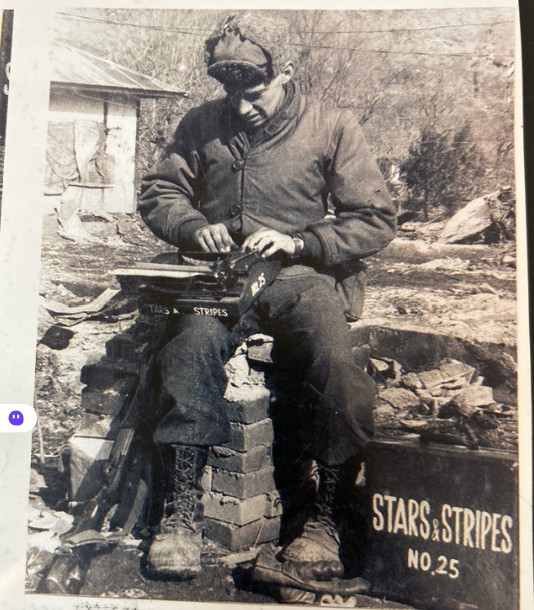
One of the most memorable images of Millholland shows him near Taegu, South Korea, in 1951, seated outdoors with his M-1 rifle and Stars and Stripes typewriter while working on a story.
He referred to this scene as the “News Room Al Fresco.”
The photograph captures the reality of Korean War journalism: correspondents often worked without a traditional newsroom, writing from tents, roadsides, division headquarters, and the field. For Millholland, the tools of his trade included both a rifle and a typewriter.
Korean War Stories from the 7th Infantry Division
As a Stars and Stripes correspondent with the 7th Infantry Division, Millholland covered the war from the perspective of those living it.
His reporting included stories about:
- Combat engineers building roads, bridges, and airstrips
- Soldiers serving near the front lines
- Tactical briefings and military operations
- Commanders and their decisions
- Human-interest stories from the field
- The humor, fear, exhaustion, and courage of wartime service
Millholland later recalled that soldiers often greeted him with a familiar request: asking whether he could “put their name in the paper.” For many service members, Stars and Stripes was more than news. It was a connection to recognition, community, and home.
Why Arthur “Mac” Millholland’s Story Matters
Arthur “Mac” Millholland’s memoir offers a vivid firsthand account of Korean War journalism and the role of Stars and Stripes in military life.
His story helps preserve the history of:
- Korean War veterans
- U.S. Army correspondents
- The Pacific Stars and Stripes
- Military journalism during wartime
- The 7th Infantry Division in Korea
- The personal experiences behind battlefield reporting
Millholland’s service reminds us that Stars and Stripes correspondents were often close to danger while working to document the stories of those in uniform.
Read Arthur “Mac” Millholland’s Full Memoir and View His Photo Gallery
To learn more about Arthur “Mac” Millholland’s Korean War service, read his full memoir and view his photo gallery through the Korean War Educator.
Read Arthur “Mac” Millholland’s Memoir and View Photo Gallery
Visit the Stars and Stripes National Museum and Library
Visitors can also learn more about Arthur “Mac” Millholland and the legacy of Stars and Stripes at the Stars and Stripes National Museum and Library.
Our exhibits preserve the stories of the men and women who reported, wrote, illustrated, photographed, printed, delivered, and read Stars and Stripes across generations.
Visit the museum to explore the history of Stars and Stripes, Korean War reporting, military journalism, and the service members whose stories continue to inspire.